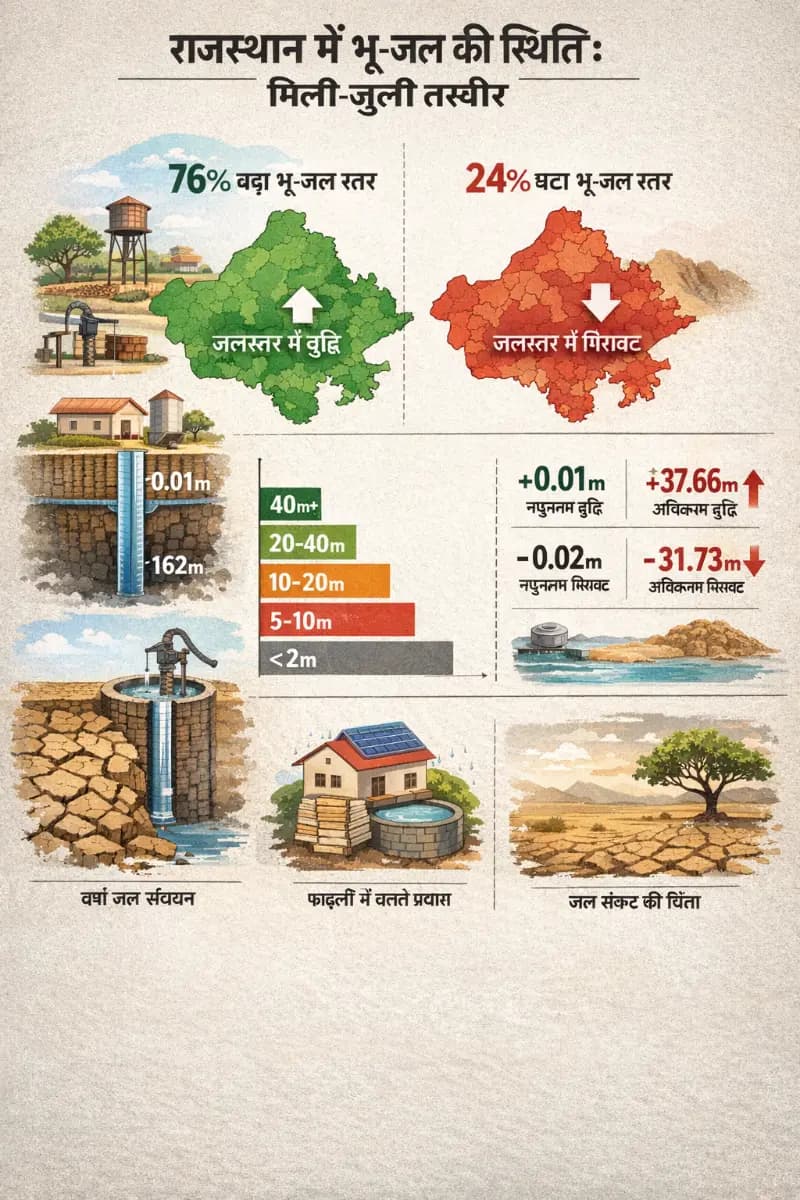
News of groundwater in Rajasthan has brought both relief and concern. According to the latest report, groundwater levels have improved in approximately 76 percent of the state's areas over the past year, while water levels have declined in approximately 24 percent. The report is based on a study conducted by the Central Ground Water Board in January 2026 at 2,191 locations.
Somewhere the water is very close to the ground, somewhere the crisis is deep inside
According to the report, the highest groundwater level was recorded in Koshithal in Bhilwara district, where water is at a depth of just 0.01 meters. In contrast, in Abhaysinghpura, Bikaner, groundwater has reached a depth of 162 meters, indicating a serious water crisis.
Current groundwater situation: Alarm bells ring in many districts
Groundwater levels have dropped below 40 meters in about 22% of the state, including districts like Nagaur, Shekhawati, Bikaner, Jodhpur, Alwar, Jaisalmer, Barmer, Jaipur-Dausa, and Jalore.
At 17% places the water level is between 20 to 40 meters, at 15% places it is between 10 to 20 meters and at 16% places it is between 5 to 10 meters.
About 19% of areas have water at depths of 2 to 5 meters, while 11% have water at depths of less than 2 meters. These include Ajmer, Tonk, Pali, Baran, Bhilwara, Bundi, Rajsamand, Kota, Sawai Madhopur, Chittorgarh, and Udaipur.
Water level increased in more than 67% areas
The report shows that groundwater levels have increased at 67.2% locations.
The minimum rise of 0.01 metres was recorded at Arjana in Jaisalmer and Binjawari in Bikaner.
The maximum increase of 37.66 meters was seen in Saypur Pakhar of Chausa.
41.6% of the areas experienced a rise of less than 2 metres, mainly in eastern Rajasthan.
12.9% of the areas recorded a rise of more than 4 metres, spread across the eastern, south-western, north-eastern and central parts of the state.
Groundwater levels have fallen rapidly in many areas.
Groundwater levels have declined in about 32.8% of the locations, particularly in the western, northern and north-eastern regions.
The minimum fall of 0.02 metres was recorded at Ramsinghpura in Sriganganagar.
The maximum fall of 31.73 meters was observed in Dhod of Sikar.
In 22.9% of the areas the fall was less than 2 metres and in 4.2% the fall was between 2 and 4 metres.
Laxity on water conservation, dependence on rain persists
According to experts, there is still a lack of seriousness regarding rainwater conservation in the state. Millions of liters of rainwater are wasted every year, while government efforts remain largely confined to paper. The improvement in groundwater levels seen is largely the result of good rainfall, not concrete water conservation plans.
The groundwater situation in Rajasthan is not completely balanced. While improvements in many areas offer hope, rapidly declining water levels in some regions signal a danger for the future. If effective water conservation measures are not implemented in time, the water crisis could worsen in the coming years.